Maryland Planting Dates: Shifting Schedules by Region and County
A planting calendar can be a useful starting point, but Maryland gardeners quickly find that a date that works in one place may not suit another. Elevation, exposure, soil conditions, and the season’s weather all affect when a bed is ready. Use the central Maryland schedule as a reference, then adjust thoughtfully for your region and the conditions in your own yard.
Why Maryland planting dates shift
A planting calendar turns a complicated growing season into a manageable plan. It helps you decide when to sow seeds, set out transplants, and make room for crops that follow earlier harvests. But a calendar date is not a promise that the weather or soil will cooperate. Maryland’s regions vary, and conditions can differ within the same county, neighborhood, or property.
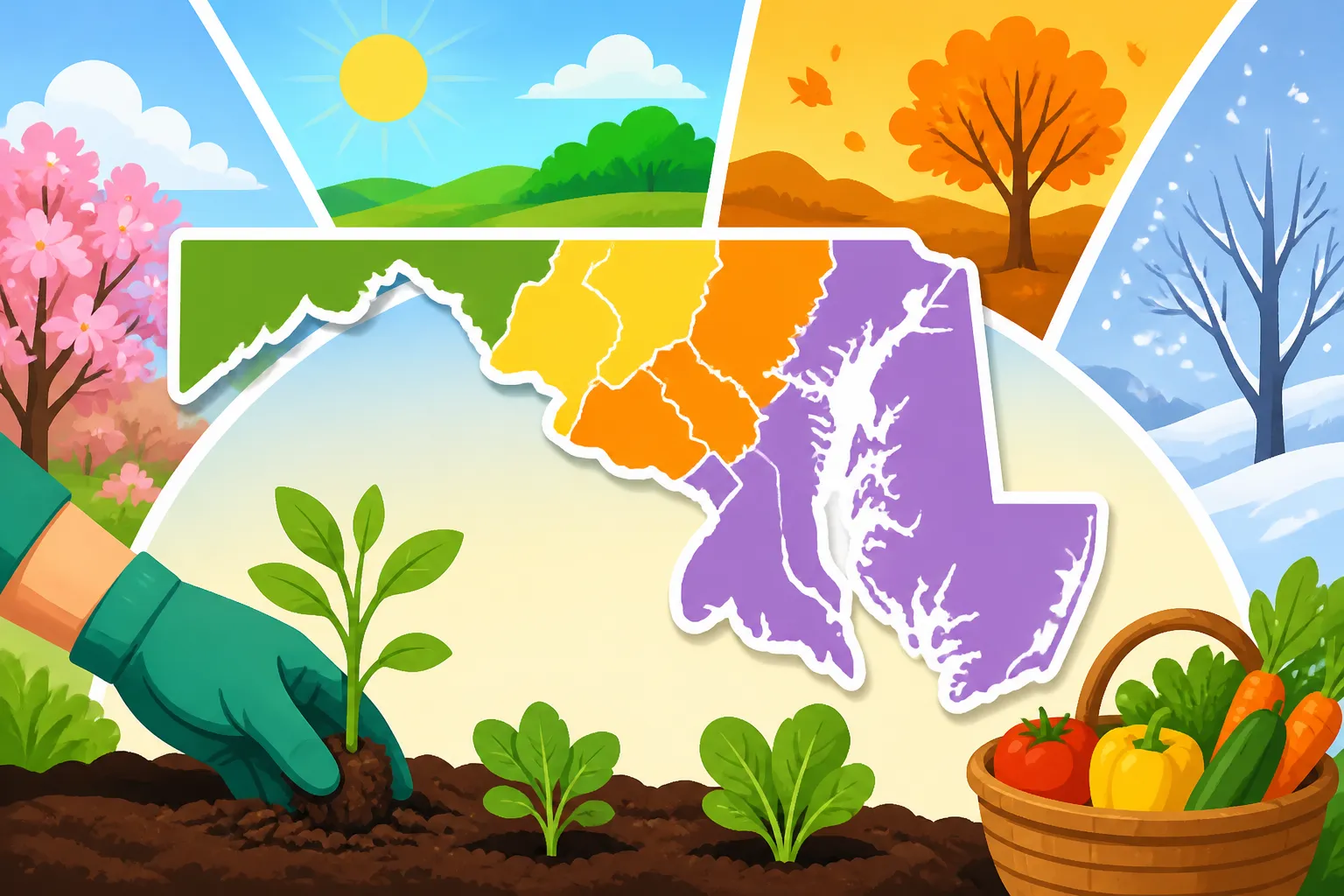
The University of Maryland Extension explains that its vegetable planting calendar was created for central Maryland, and gardeners can shift planting a week or two earlier (Southern Maryland, the Eastern Shore, and Baltimore) or later (Western and Northern Maryland). Treat this as a regional starting point, not a precise instruction for every garden.
A schedule that is early enough for a sheltered bed may be premature for a cool, exposed one. Likewise, a date that is cautious for a high, windy garden could leave a warm, protected spot waiting longer than it needs to. The useful question is not simply, “What date does the calendar say?” It is, “What is happening in my garden, and what does this crop need before I plant it?”
That distinction matters because crops respond to different conditions. Cool-season vegetables can tolerate cooler growing weather than warm-season crops, but their seeds still need suitable conditions to germinate. A tomato transplant may be ready to leave its pot while the soil in the garden remains cool. A planting date that is appropriate for sowing seed directly into soil may not be the right date for moving a tender plant outdoors.
Weather adds another layer of uncertainty. A stretch of mild afternoons can make a garden feel ready, followed by cold nights or a sudden wet spell. A warm spring does not guarantee that the growing conditions will stay warm. For that reason, the most dependable approach combines a calendar with current observations and a willingness to wait when the garden is not ready.
It also helps to separate three questions that are often blended together:
- When does a crop usually fit into the growing season?
- What conditions does that crop need to germinate or establish?
- Is the garden currently providing those conditions?
A regional planting calendar is useful for the first question. Your crop’s needs and local garden observations help answer the other two. For broader seasonal context, see Maryland Growing Season Calendar: From Spring Thaw to Fall Freeze and Maryland Vegetable Planting: Spring and Fall Growing Windows.
Use your region as a starting point, then read your yard
Regional guidance is useful because it gives gardeners a shared point of reference. It cannot account for every change in slope, shade, wind, soil, or shelter. When you adjust a schedule, consider both the wider region and the specific spot where the crop will grow.
Southern Maryland, the Eastern Shore, and Baltimore
The central Maryland calendar can be adjusted earlier for Southern Maryland, the Eastern Shore, and Baltimore, as described in the Extension guidance above. That does not mean every garden in those places should be planted on the earliest possible schedule. A sheltered bed with workable soil may be ready before a low, wet, or wind-exposed bed nearby.
The phrase “earlier” is best understood as a prompt to check conditions sooner, not an instruction to plant regardless of conditions. Look at the forecast, feel the soil, and consider how the site has behaved in recent seasons. If your garden tends to hold water after rain or remain cold in shade, its planting readiness may lag behind a sunnier, better-drained spot in the same area.
Western and Northern Maryland
The Extension calendar can be shifted later for Western and Northern Maryland. Gardeners in these regions should be especially attentive to how elevation, exposure, and local terrain affect spring conditions. A garden on a sheltered site may warm and dry differently from an exposed one, even when both are in the same broad region.
A later regional schedule can be a practical safeguard against rushing crops into conditions they cannot use well. At the same time, it should not be treated as a reason to delay every crop automatically. Cool-season crops and warm-season crops have different needs, and a protected bed can behave differently from a garden that is open to wind and cold air.
County names do not describe every garden
A county-level calendar can narrow the starting point, but a county boundary does not create a uniform growing environment. There may be meaningful differences between a sunny urban yard, a low-lying garden, an exposed ridge, and a sheltered bed near a building. Even neighboring properties can have different amounts of sun and wind protection.
Use the county or region as a broad reference, then make a more local adjustment based on your site. If a local schedule gives a planting window, treat it as a guide to investigate rather than a guarantee. The conditions in your bed still matter.
The same principle applies when comparing advice from different calendars. One calendar may represent a central location, while another may describe a particular region or crop. Rather than forcing them to match exactly, check what each schedule is based on and whether its planting method suits your plan. Maryland Planting Dates: Shifting Schedules by Region and County is the topic here; for seasonal crop timing, Maryland Planting Calendar: What to Sow and Harvest Now can help connect planting plans with the wider garden year.
Adjust by crop, not by date alone
A useful calendar separates crops by what they need rather than treating the whole garden as a single planting project. The readiness of one bed does not mean every crop is ready to go in. Before adjusting a planting date, identify whether you are sowing seed directly, transplanting a young plant, or moving a crop into a protected growing space.
Cool-season crops
Cool-season crops are generally planned for the cooler parts of the growing season. Their relative tolerance of cool weather does not mean they will thrive in every cold, saturated, or compacted bed. Seeds need suitable soil conditions, and young plants need a chance to establish without being battered by harsh weather.
For direct-sown crops, check whether the soil is workable rather than clinging wet or forming hard clods. If soil is too wet, working it can damage its structure and make it harder for roots to grow. If conditions are dry and crumbly, prepare the bed gently and sow according to the crop’s needs.
A cool-season schedule may also include more than one planting window. Some crops can be grown in a spring window and again as the season cools, while others are better suited to one part of the year. Do not assume that moving a spring date earlier automatically makes a crop suitable for the hottest part of summer. Consult crop-specific guidance when the season changes. For examples of cool-season timing, see Maryland Fall Vegetable Gardening Guide: Timing Cool-Season Crops and When to Plant Fall Vegetables, Brassicas, and Garlic in Maryland.
Warm-season crops
Warm-season crops need more than a calendar date that looks favorable. Their seeds and roots need soil and weather conditions suited to growth. A run of warm afternoons can be misleading if the ground remains cool or nights are still unsettled.
A good test is to check the crop’s specific guidance and compare it with conditions in your bed. Avoid treating a warm day as a signal that all tender crops can be planted. If the forecast turns cold again, a young transplant can be stressed even when the afternoon felt comfortable.
Warm-season crops are often started indoors or purchased as young plants, but transplants still need a careful transition. A plant raised in a protected setting has not yet adjusted to direct sun, wind, and outdoor temperature swings. Use a gradual acclimation process rather than moving it straight from shelter into a demanding garden spot. When to Start Seeds Indoors and Transplant in Maryland and Acclimating Tender Transplants to Maryland Garden Beds cover these parts of the process.
Direct-sowing and transplanting are different decisions
A calendar may list a planting window without making clear whether it refers to seeds, transplants, or both. Those methods do not always share the same readiness conditions. A seed placed in the ground experiences the soil environment from the start. A transplant already has leaves and roots, and it must adjust to the garden after being moved.
For direct sowing, focus on soil condition, seed depth, and the crop’s germination needs. Avoid sowing into soil that is too wet to work or likely to crust before seedlings emerge. For transplants, check the plant’s health, harden it off gradually, and choose a period when it can establish without a sharp change in conditions.
The distinction can change how you use a date. If the calendar suggests a crop is entering its planting window but your bed remains cold and wet, waiting may be more useful than sowing immediately. If a transplant is ready but outdoor conditions remain unsettled, keep it protected until the site is suitable. See Direct-Sowing vs Starting Seedlings Indoors for Long Seasons for help choosing a method, and Understanding Days to Maturity: Direct Sowing vs Transplants for thinking through how the choice affects the available growing window.
Build a local adjustment from practical observations
You do not need to predict the entire season to improve a planting schedule. Instead, gather a few kinds of local information and use them together. A simple record of what you planted, the conditions you observed, and how the crop established can make future decisions more grounded.
Check the forecast without treating it as a guarantee
Before planting, look at the forecast for changing conditions, not only the next mild afternoon. A forecast can help you notice a possible cold spell, heavy rain, strong wind, or abrupt temperature change. It cannot guarantee that conditions will unfold exactly as predicted, so keep checking after you plant.
For tender transplants, pay attention to conditions that could interfere with establishment. For direct-sown seeds, consider whether expected rain may wash soil, leave the bed waterlogged, or create a surface crust. The appropriate response depends on the crop and the bed, but the forecast is one part of the decision rather than the whole decision.
A forecast also needs to be interpreted locally. Weather conditions at a nearby reporting point may not match a sheltered yard, a low spot, or an exposed garden. If your garden routinely feels colder or windier than the broader forecast suggests, account for that pattern when you make plans. Monitoring Local Weather Forecasts for Sudden Spring Freezes offers more detail on using forecasts as a planning tool.
Observe soil and drainage
Soil readiness is not the same as air temperature. A bed can feel warm in the sun while remaining cool below the surface. It can also stay wet after rain even when the surrounding yard looks dry. Before disturbing a bed or sowing seed, check the soil where the crop will grow.
If the soil is soggy, delay work that would compact or smear it. If it is dry, decide whether it needs water before sowing, following the needs of the crop and the conditions in the bed. Raised beds and containers can warm or dry differently from in-ground soil, so do not assume that a date suited to one planting space fits another. For help diagnosing how soil affects timing, see How Cold Soil Temperatures Slow Down Spring Seed Germination and Managing Soil Moisture Across Maryland Clay, Loam, and Sand.
Drainage can be a persistent local factor. A bed that stays wet may be slow to become workable and may be a poor fit for crops that need well-drained conditions. A sandy or elevated bed may dry quickly and need closer attention to moisture after sowing. The adjustment is not always simply to plant earlier or later; sometimes the more useful change is to improve the bed, choose a better planting spot, or select a crop suited to the site.
Notice exposure, slope, and shelter
Sun and wind influence how quickly a garden warms and how much moisture it loses. A sunny spot may become workable sooner than a shaded one, but it may also dry out faster. A fence or building can block wind or create shelter, while a low-lying area can collect cold air or remain damp.
Use these features to explain why a bed behaves differently from the wider area. Keep observations specific: note where snow or frost tends to linger, where soil dries quickly, and which beds are exposed to prevailing wind. Avoid assuming that a feature is always beneficial. A sheltered location may be warmer, but it may also receive less air movement or become hot later in the season.
If your garden includes distinct growing areas, plan for each one separately. You might sow in a sheltered bed while waiting to plant the more exposed bed, or protect young plants in the location that is most vulnerable. Garden Microclimates: How Wind and Fences Alter Spring Frost and Sheltered Microclimates: How Buildings Shift Yard Freeze Dates explain why small site differences can matter.
Keep a record that is useful next season
A gardening record does not need to be elaborate. Note what you planted, where it went, whether it was seed or a transplant, and how the bed performed. Include observations such as wet soil, slow emergence, cold damage, heat stress, or unusually quick drying. Record what happened rather than only what you planned.
These notes help distinguish a calendar problem from a site problem. If seedlings repeatedly struggle in the same low bed, the cause may be drainage or cold-air exposure rather than the regional planting date. If a sunny container dries quickly after planting, the issue may be water management rather than an incorrect calendar window.
Use records as a guide, not a rigid rule. Weather changes from season to season, and a date that worked under one set of conditions may not work the next time. Keeping Garden Records to Plan Next Year’s Planting Schedule offers ideas for making those notes easier to use.
A practical planning table for regional and county decisions
The following table is not a replacement for crop-specific dates. It is a way to decide what to check before following a calendar entry. Start with the broad regional schedule, then match the decision to the crop and bed.
| Planning question | What to check | How to use the result |
|---|---|---|
| Which regional schedule is the starting point? | Whether the calendar represents central Maryland, a region, or a local growing area | Use the closest relevant guidance as a reference, not a guarantee |
| Is the crop cool-season or warm-season? | The crop’s preferred growing conditions and sensitivity to cold | Avoid moving all crops together just because one group is ready |
| Are you sowing seed or transplanting? | Germination needs for seed, or establishment needs for a young plant | Follow the method-specific advice rather than assuming the dates are interchangeable |
| Is the bed ready to work? | Whether soil is workable, drained, and suitable for the crop | Delay soil work if it would compact wet soil; prepare the bed when conditions are suitable |
| Is the site unusually exposed or sheltered? | Sun, wind, slope, shade, and patterns of lingering cold or moisture | Adjust for the bed’s behavior, even when it differs from nearby gardens |
| What does the near-term forecast suggest? | Possible cold, wind, heavy rain, or abrupt changes | Use the forecast to identify risks, then keep monitoring conditions |
| Does this county guidance fit the actual location? | Local landscape differences within the county | Treat a county schedule as a broad guide and verify local conditions |
| Did past plantings establish well? | Garden notes on emergence, stress, drainage, and harvest | Use repeated patterns to refine the next plan without assuming every season will match |
This process is useful when a calendar gives a clear date but the garden gives mixed signals. A crop may be in its general planting window while the bed is still too wet. A transplant may be healthy but not yet accustomed to outdoor exposure. A warm spell may be encouraging, while the forecast indicates unsettled weather ahead.
The table also helps when different sources appear to disagree. Check whether the sources refer to the same region, crop type, planting method, and growing space. One recommendation may assume direct sowing while another assumes a transplant. One may describe a regional average while another focuses on a specific site. Once those assumptions are clear, the advice is often easier to compare.
For a broad calendar, see [Central Maryland Planting Calendar: Sowing and Harvest Windows]. If you are planning around local frost information, use Finding Local Frost and Freeze Date Normals for Your Maryland Town as a starting point for locating local information. Frost dates are estimates based on probabilities, not fixed guarantees; a planting decision should also take current conditions and the needs of the crop into account.
Turn a calendar into a flexible garden plan
A calendar is most helpful when it supports a sequence of decisions, rather than a single planting day. Plan the garden in phases: prepare the bed, check conditions, plant what is ready, and leave room to adjust. This reduces the pressure to complete every planting at once and gives you a chance to respond to changing weather.
Start with a regional reference
Choose the planting calendar that best reflects your part of Maryland. If it is based on central Maryland, recognize that its dates may need adjustment for a different region. If it is local, check whether it refers to your crop and method. Keep the reference visible when planning, but do not treat it as an order to plant on a particular day.
Write down the crops you want to grow and identify the planting method for each. Mark which crops need direct sowing and which are likely to be transplanted. That simple distinction makes it easier to avoid applying one schedule to every crop.
Work backward from the harvest you want
Think about when you hope to harvest and what the crop needs to reach that point. Crop development takes time, and the available growing window varies by crop and conditions. Use crop-specific guidance to understand how long the crop generally takes and whether your plan leaves adequate time for establishment and growth.
This is especially useful for fall crops. A late-summer planting has to establish while the weather may still be hot, then continue growing as conditions cool. Waiting for the weather to feel comfortable can mean the crop has less time to mature. At the same time, sowing into harsh conditions without protection can make establishment difficult. Timing and management have to work together. See Planning Fall Vegetable Beds Around Maryland Freeze Dates and Planning Fall Harvests Ahead of Significant Autumn Frost for ways to think ahead.
Prepare for a staggered schedule
Beds do not have to be planted all at once. A staggered plan lets you respond to local conditions and makes room for successive crops. You might plant a suitable crop in a ready bed while leaving another bed until it drains or warms. You can also use successive sowings when the crop and season allow, rather than trying to get every plant established on the same day.
Staggering can also help with harvest management. If a crop matures all at once, you may have more produce than you can use. A succession plan can spread harvests, but it depends on the crop, the season, and the remaining growing window. Check whether the crop can be sown repeatedly at that point in the season before assuming a new sowing will mature. For practical planning, see Succession Planting in Maryland: Which Crops to Sow Repeatedly and Setting Up a Seasonal Calendar for Successive Seed Sowing.
Leave room for changes
A plan should be easy to revise. If rain keeps the bed too wet, shift the task rather than forcing the soil into shape. If a cold period appears in the forecast, protect sensitive plants where appropriate or wait to plant them. If a crop is delayed, check whether the remaining season is still suitable before sowing or transplanting.
Keep backup options in mind. A crop that is late may still fit the garden if you choose a shorter-maturing option recommended for Maryland or use a transplant instead of starting from seed. Do not assume a substitute will behave identically; compare its growing needs and maturity information before changing the plan.
For gardeners who start late, buying ready-to-plant starts can sometimes save time, but the plants still need suitable conditions and careful acclimation. A larger plant is not automatically more resilient if it has been raised under protected conditions. Starting Late in Maryland: When to Buy Starts Over Seeds can help weigh that option against direct sowing or indoor seed starting.
Protect the planting after it goes in
Planting is not the end of the decision. Seeds need moisture and appropriate soil conditions to emerge. Transplants need water and time to establish. Young plants may need protection from wind, sudden temperature changes, or intense sun, depending on the crop and site.
Check the garden after planting instead of assuming the calendar has done its job. Look for missing seedlings, washed-out rows, wilting, or soil that has dried or stayed saturated. Respond to what you see, and avoid unnecessary interventions that could create a new problem.
When using covers or other protective materials, consider the conditions they create. A cover can help buffer exposure, but it may also trap heat or reduce airflow. Follow crop-specific recommendations and monitor plants rather than leaving protection in place without checking. See Protecting Early Spring Starts During Sudden Night Temperature Drops and Extending Fall Vegetable Harvests in Maryland with Floating Row Covers for examples of how protection can fit into a seasonal plan.
Common mistakes when shifting planting dates
A regional adjustment can improve a plan, but it is easy to overinterpret. These common mistakes can lead to wasted seed, stressed transplants, or missed harvest opportunities.
Treating a regional shift as a local guarantee
Regional timing is a broad guide. It does not mean every bed in the named area is ready at the same moment. Compare your site with the conditions the calendar assumes, and adjust for slope, drainage, exposure, and shelter.
The opposite mistake is to ignore regional guidance altogether and rely only on a warm afternoon or a neighbor’s planting date. A neighbor may have different soil, a protected bed, a different crop, or a different tolerance for risk. Use other gardeners’ observations as useful context, not as a substitute for checking your own conditions.
Moving all crops together
It is tempting to shift the entire garden forward or backward as a block. That can put cool-season and warm-season crops into conditions they do not share. Separate crops by temperature preference, planting method, and sensitivity to weather. A single regional adjustment should not erase those differences.
Confusing a calendar date with soil readiness
A planting date cannot make wet soil workable or warm cold soil. If a bed is saturated, working it can harm its structure. If a seed needs warmer conditions than the soil provides, sowing early may not produce earlier growth. Check both the crop guidance and the actual bed.
Assuming a mild spell means the season has settled
Warm weather can encourage premature planting, especially for tender crops. Look beyond current daytime conditions and consider the likely pattern ahead. Continue to monitor after planting, because a suitable day does not guarantee a stable stretch of weather.
Forgetting that containers and raised beds behave differently
Containers and raised beds may drain, warm, and dry differently from in-ground beds. A schedule suited to one setup may not transfer directly to another. Containers can also be more exposed to wind and rapid drying, while raised beds may have different soil conditions from the surrounding yard.
If you garden in pots, consider their placement and how quickly the growing medium changes after rain or sun. Use container-specific advice rather than copying an in-ground schedule without adjustment. Growing Vegetables in Containers and Compact Spaces and When to Start a Container Garden in Maryland for Best Growth are useful starting points.
Planting without a follow-up plan
A planting date is only part of the work. Seeds and transplants need follow-up attention as weather changes. Plan to check moisture, emergence, plant condition, and protection needs. A quick inspection after rain or a sudden weather shift can reveal problems while they are still manageable.
Frequently Asked Questions
Should I follow a central Maryland calendar if I garden elsewhere?
Use it as a reference, then adjust for your region, crop, planting method, and garden conditions. A calendar is most useful when you check whether its assumptions fit your site.
Why might two gardens in the same county have different planting windows?
Gardens can differ in sun, wind exposure, slope, drainage, shelter, and soil. Those conditions affect how quickly a bed becomes workable and how well a crop establishes.
Should every crop be planted earlier in a warmer-feeling spring?
No. Crops have different temperature and establishment needs, and a mild stretch does not ensure that conditions will remain favorable. Check the crop’s guidance and the forecast before planting.
Is a planting date the same for seeds and transplants?
Not necessarily. Seeds depend on suitable conditions in the soil to germinate, while transplants must adjust to outdoor conditions and establish after they are moved. Check advice for the specific planting method.
Sources
- University of Maryland Extension — When to Plant Vegetables | University of Maryland Extension (checked November 15, 2026)
Disclaimer
This article is for general informational purposes only and does not constitute professional advice. Laws, prices and regulations vary by location and change over time. Consult a qualified professional for guidance on your specific situation. Maryland Gardening Guide is not a government agency and is not affiliated with any university extension, state department of agriculture or other government agency.